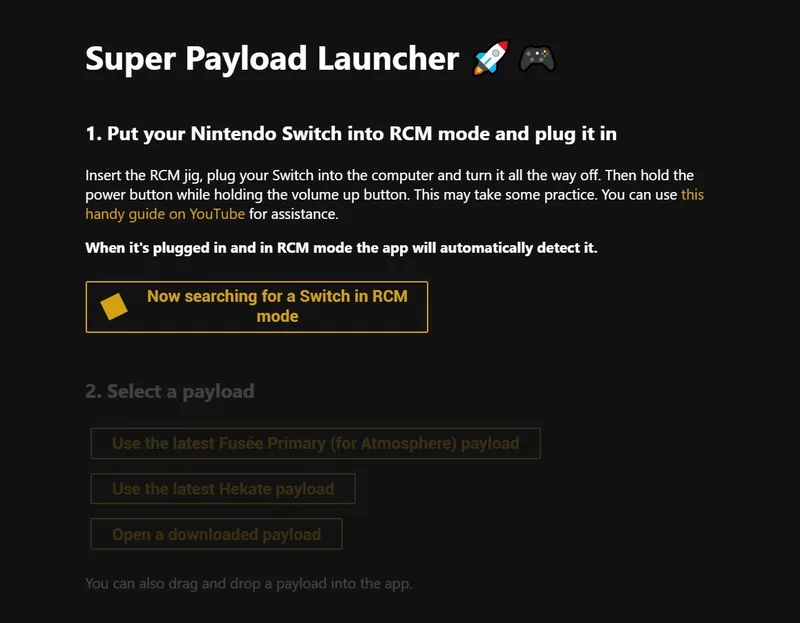
Early Nintendo Switch consoles have a hardware flaw in their recovery mode. Connect one to a computer over USB and the computer can send it a small program, a “payload”, that boots homebrew firmware such as Atmosphère or Hekate. The tools for this mostly ran on one operating system and assumed a developer was at the keyboard. Super Payload Launcher runs on Windows, macOS and Linux, and walks anyone through it.
Making it simple
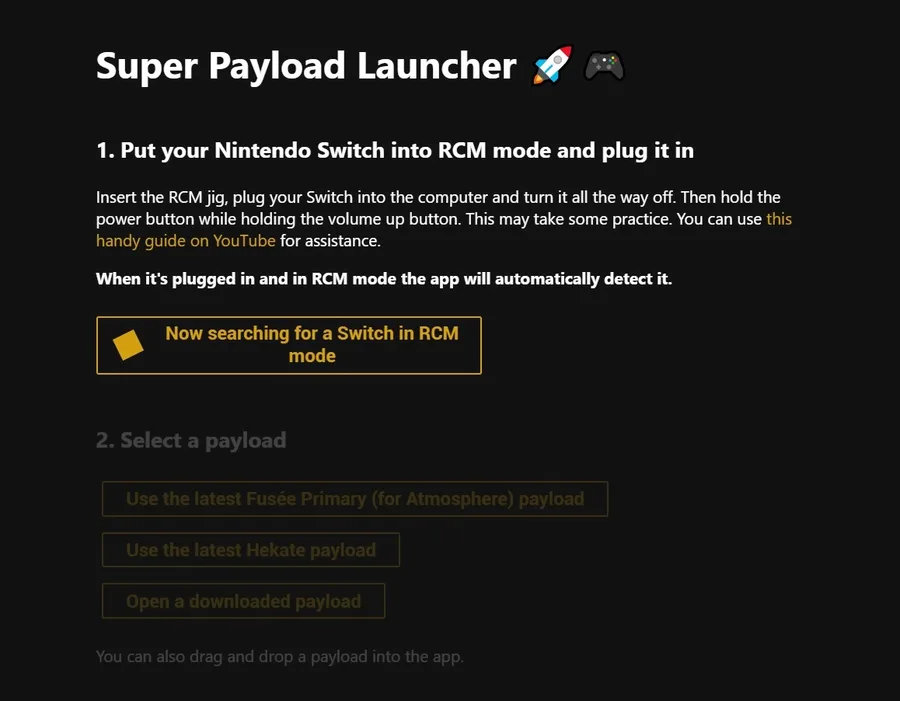
- It finds the console for you. The app watches for a Switch in recovery mode and moves on by itself when one is plugged in.
- It fetches the payloads. One button downloads the latest Atmosphère or Hekate release directly from its project’s GitHub releases, so nobody has to hunt for the right file.
- It remembers. You can mark a payload as a favourite and have it sent automatically the next time the console is connected.
- It handles drivers. On Windows, it offers to install the USB driver the console needs the first time you use it.
- It speaks your language. All the text comes from translation files, ready for other languages.
Talking to hardware
This was my first time sending raw data to a device over USB, and each operating system has different rules for it. On macOS and Linux the app talks to the console directly through a WebUSB library. On Windows it hands off to a proven community tool, because the USB library was unreliable there. Some timeouts that look like errors are normal once the payload lands and the console reboots, so the app has to tell a real failure from a success that looks like one.
A first step into the web stack
It was my first project with Node, TypeScript and Electron, and my first time writing HTML and CSS. Even then I set it up the safer way. The interface runs isolated from Node, and it can only ask the main process to do a short list of named things, rather than having the run of the machine.
Reception
It became my most-starred repository on GitHub and was downloaded hundreds of times. It was satisfying to give something free and useful back to a community I had learned a lot from.
Standing on others’ work
None of it would exist without the people who found and documented the exploit, and those who maintain the firmware it boots: Kate Temkin, Rajko Stojadinovic (whose tool powers the Windows side), Michael “SciresM” (Atmosphère) and CTCaer (Hekate).