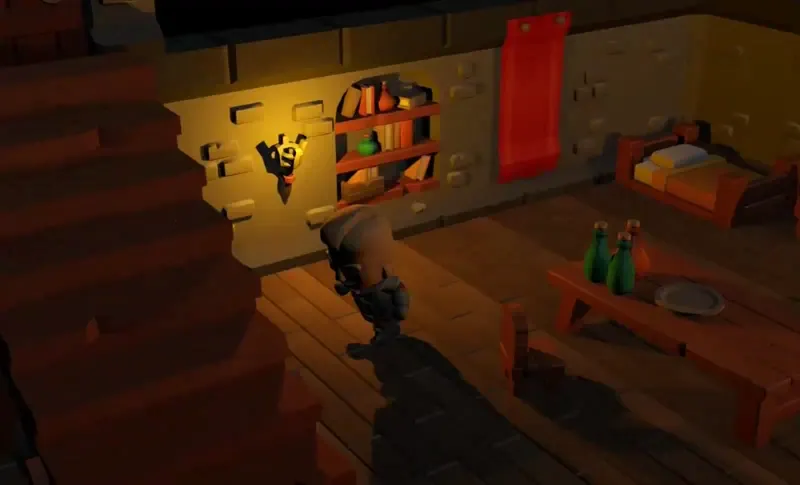
Deep Down is a prototype for a 3D game that mixes platforming, puzzles and a little dungeon crawling. You wake at the bottom of a huge castle-like cavern and have to work your way up, finding out on the way why you were there in the first place. The name is a working title; the idea isn’t. It was my move from 2D games into 3D, which meant learning physics and modern lighting properly.
Physics as puzzles
Every object in the world is simulated, and the puzzles are built on that. Levels are kept deliberately small, so the interactions can be rich without asking too much of the player’s processor.
Light as puzzles
The lighting uses ray tracing, so shadows are accurate. One puzzle relies on this: there is a shape marked on a wall, and you have to place an object so that a lamp casts exactly that shadow onto it, which opens the way forward.
Ray tracing is expensive, but it doesn’t have to be. A low-poly art style and levels designed to keep moving, complex objects to a minimum keep the cost down. It also supports software ray tracing, so it runs on ordinary machines, not only the latest graphics cards.
Where it stands
A Windows build of the demo exists; it targets desktop only because of its rendering demands. Like Pocket Wars, it is built in Godot, with the level structure heavily customised.